

The Engineering Leader’s Case for Unified Platform Orchestration
Software teams are not slowing down because of a lack of tools. Most organizations have more tools than they can effectively manage—and that fragmentation is precisely what stalls delivery. Disparate systems create visibility gaps, manual reconciliation overhead, and decision-making blind spots that accumulate sprint over sprint. A Software Engineering Orchestration Platform addresses the root cause rather than the symptoms, unifying the systems that govern how software actually gets built and shipped.
Why Fragmented Tooling Creates Structural Risk
When engineering work happens across disconnected tools, no single stakeholder has a complete picture. Commits live in one system, deployment status in another, sprint velocity in a third. Leadership makes decisions based on lagging indicators. Teams waste hours reconciling data that should flow automatically.
The downstream effects are measurable: delayed releases, cost overruns, engineer attrition, and a growing gap between roadmap commitments and actual delivery. These are not talent problems or process problems in isolation—they are system problems.
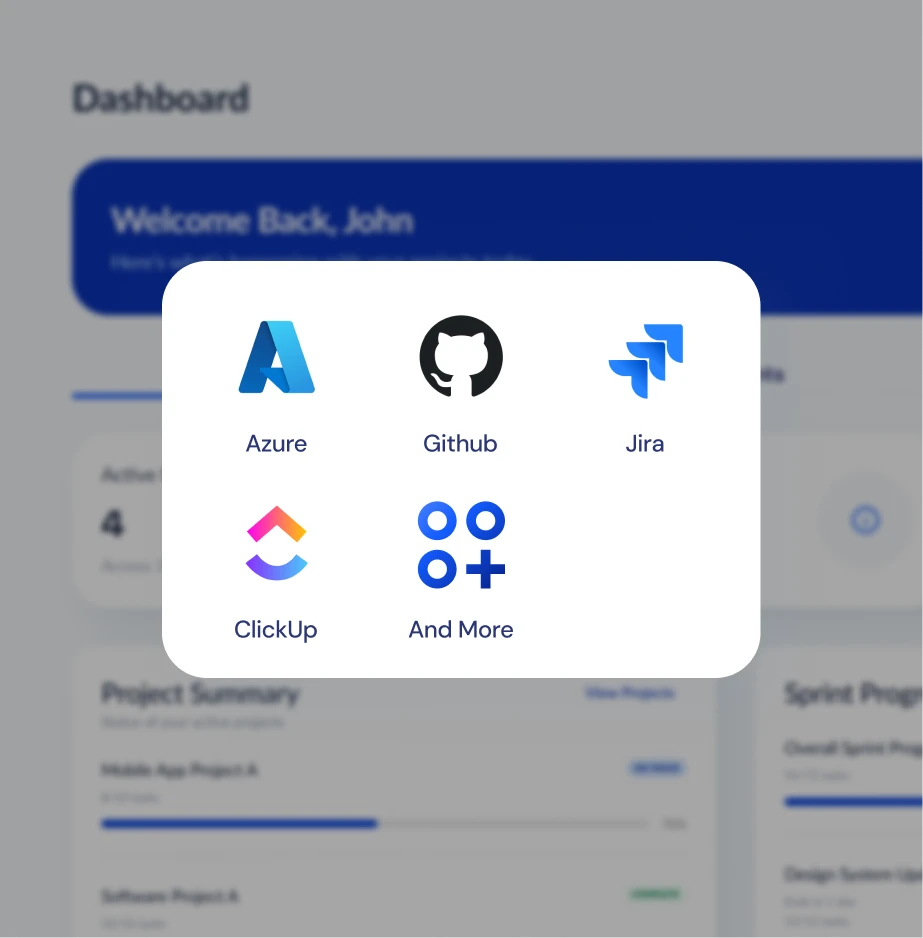
Scrums.com resolves this by normalizing activity across more than 50 platforms, including GitHub, GitLab, Jira, Linear, ClickUp, Azure DevOps, and Slack. Every commit, pull request, ticket update, and deployment feeds into a unified data layer that gives teams and leaders real-time visibility without requiring tool migration.
AI Agents That Operate Inside Governed Workflows
Artificial intelligence is most valuable in software delivery when it operates within defined boundaries, not as a standalone layer bolted on afterward. Scrums.com’s AI Agent Gateway deploys specialized agents for code review, test generation, sprint velocity forecasting, and documentation directly within existing workflows.
Each agent operates within customizable quality gates. Code review agents flag vulnerabilities before merge. Test generation agents enforce coverage thresholds. Sprint forecasting agents surface bottleneck risks before they affect delivery timelines. The result is AI acceleration that complements engineering judgment rather than bypassing it.
Deploying Talent as a Platform Primitive
One of the most distinctive aspects of the Scrums.com architecture is that talent functions as a deployable register—not an HR process. The platform’s vetted global engineering network allows teams to browse, match, and deploy skilled engineers, with AI-powered skills matching and cultural fit assessment built into the workflow.
Engineers deploy within 21 days of activation, with real-time DORA metrics tracked at the individual level from the moment they join a team. For organizations scaling quickly or managing delivery gaps, this eliminates the typical lag between identifying a resource need and putting productive capacity on the board.
Turning Engineering Data Into Executive Insight
DORA metrics—Deployment Frequency, Lead Time for Changes, Mean Time to Recovery, and Change Failure Rate—are the most validated indicators of software delivery performance. Scrums.com automates their collection from Git, CI/CD pipelines, and incident management tools, then surfaces the results in dashboards built for both engineering managers and executive stakeholders.
Compliance reporting for SOC 2 Type II, ISO 27001, and HIPAA is embedded in the same system, generating audit trails automatically rather than as a periodic manual effort. For organizations operating in regulated industries, this is a meaningful operational advantage.
From Scattered Operations to a Single Control Plane
The before-and-after of platform orchestration is concrete. Before: cloud sprawl, SaaS stack fragmentation, five AI providers with no unified oversight, costs without attribution, delivery status unknown until it is too late. After: unified pipeline orchestration, live delivery and spend visibility, one bill, one SLA, one platform.
Scrums.com has been building in this space since 2012, with a client renewal rate that reflects the depth of the platform’s integration into how teams operate.
Engineering leaders evaluating orchestration platforms should start with a clear question: how much delivery capacity is currently lost to coordination overhead? The answer almost always makes the case for a unified platform.
Scrums.com offers a free account to explore platform capabilities, with a full DORA rollup available within an hour of connecting a repository.